Talk given on the Feast of Christ the King November 24th 2024
at Holy Trinity Church, Sutton Montis.
Collect for Christ the King
God our Father Help us to hear the call of Christ the King And to follow in his service Whose kingdom has no end: For he reigns with you and the Holy Spirit One God now and forever. Amen
After a few difficult months, health wise and family wise, we’ve been away in Sicily.
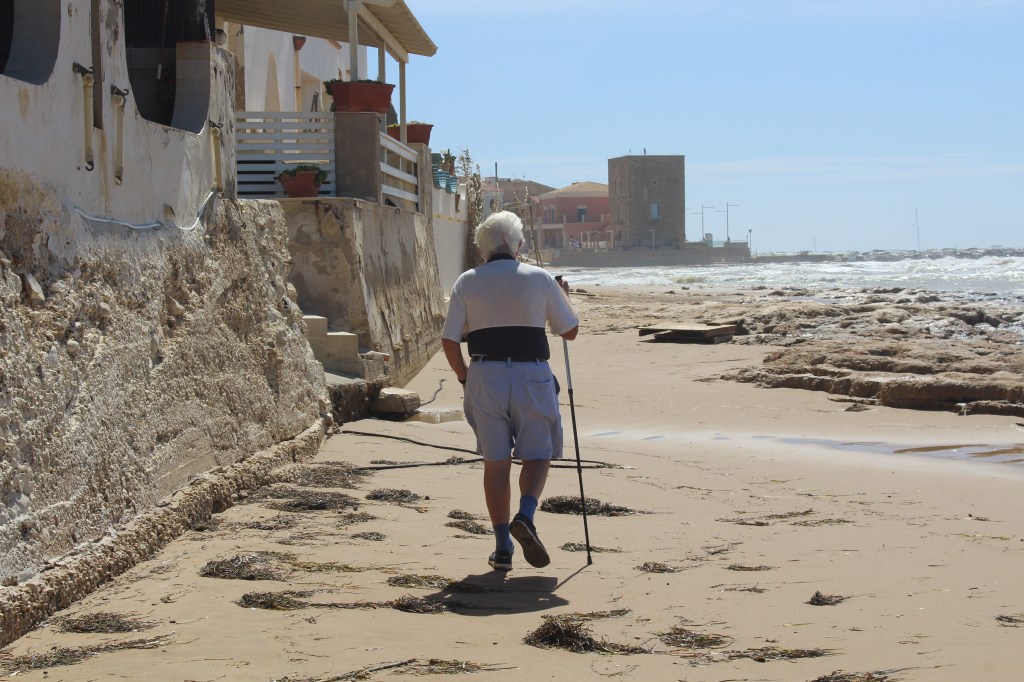
Our visit was based in Marina Di Ragusa on the southern tip of this beautiful island. Here at our lovely hotel, we received a sense of true Sicilian hospitality, they even made Alan a birthday cake! As we travelled around taking in the breathtaking views of sea and sky and felt the warmth of the sun on our bones, we both were of aware of the sense of life lived at different pace, taking time to savour each moment. So, ok, let’s take time over lunch, let’s take a break in the heat of the day, all the things we need to do will still get done by the end of the day but they will be done at our pace.
As fans of Inspector Montalbano, we got hooked several years ago on the TV series and the wonderful books by Andrea Camilleri. So, to celebrate our 40th wedding anniversary plus a milestone birthday for Alan we decided to do our own ‘in the footsteps of Montalbano’ pilgrimage.
One of the things we really loved, (and it seems to be a feature of the Mediterranean life), is the way that children are included. In the evenings walking out along the seafront small children were sharing meals with their parents in open-air restaurants. They sat at the table and were made to feel welcome. Ok there was the occasional squall from the odd terrible two- or three-year-old but it was always treated with calm, just a part of a normal rhythm, they often took some ‘breakout time’, a little walk and then came back. The most important thing seemed to be that families could eat and talk together around a table; this is something that many have commented seems to be missing in our individualistic/isolationist society back at home.
Of course, we had to visit a few churches, just to satisfy those at home who assume that clergy on holiday naturally want to spend all their time visiting something they pretty much see every day!
Sicily has some spectacular ones and some beautifully simple ones too.
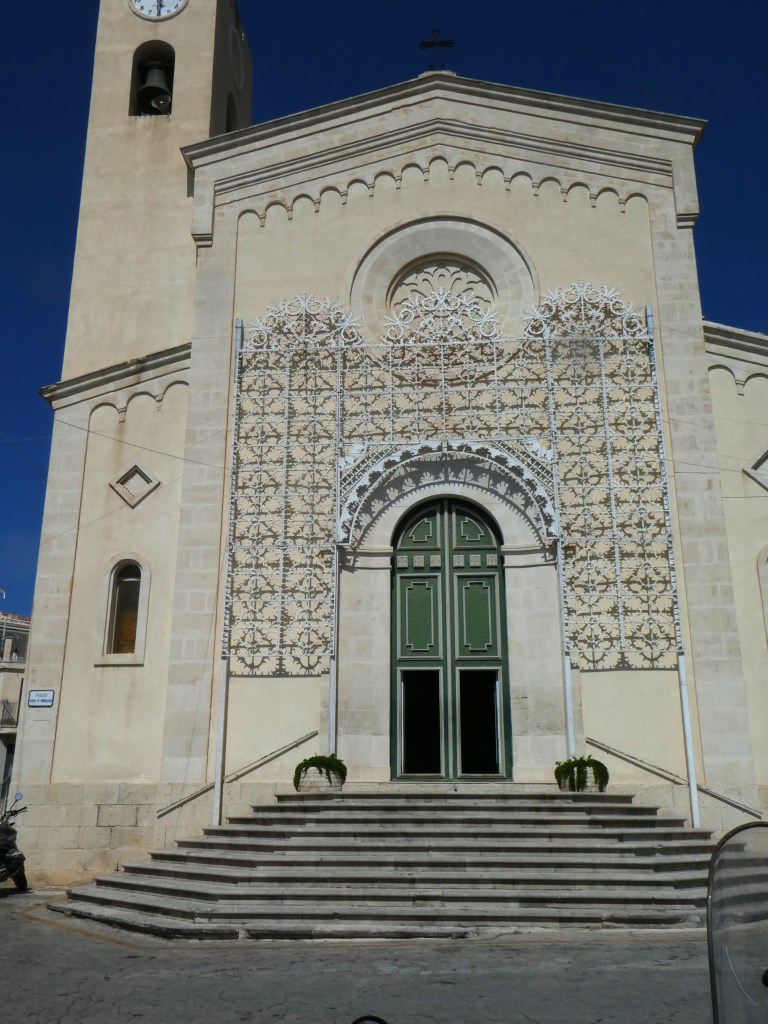
From the small church of St Maria di Portosalvo in Marina di Ragusa
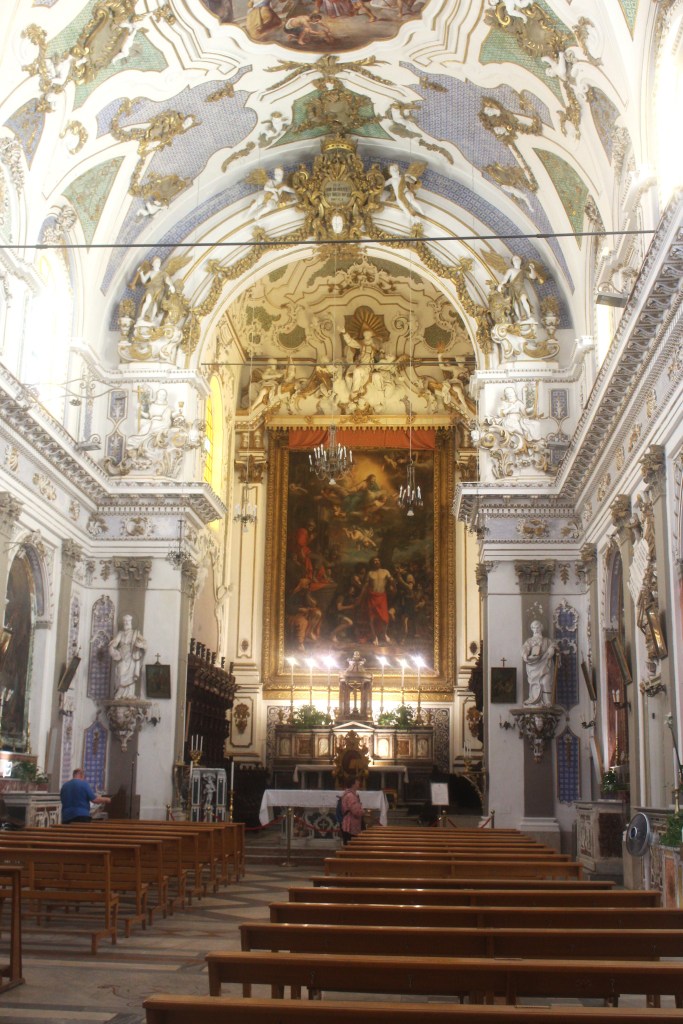
To the WOW factor of very big church of St Bartholomao in Scicli.
Where the lovely guide, who also seemed to be acting as the tourist office, furnished us with a map of the whole town and was very helpful with info not only on the holy stuff but on our Montalbano project.
In the town square church of St Ignacio, the man on duty explained to me a bit about the history, and between his faltering English and my halting Italian we seemed to make a connection. So much so that at the end of our visit he came after me with a little card in his hand, not for money, but to remind me very passionately of the importance of the story of his church, his faith, his people. As we wandered out onto the street this sparked a question in my mind: in our many beautiful churches back at home when visitors arrive how keen are we to share the story of our church, our faith our people with a similar passion and pride?
Looking around and gazing upwards whether your leanings are towards the Protestant or the Catholic, the High church or the Low you can’t help admiring the sheer beauty of the artwork on display and the effort, devotion, vision and inspiration that went into creating it. For myself as a humble ‘wordsmith’ and a bit of a musician, I stand in awe of those who create tapestries, frescoes, and great vast canvasses which fire our imagination.
Some of the works inspire us, some of them disturb, confront us and expand our boundaries, but that’s what life and faith is all about. The more we learn the more there is to learn, and when we come to the end of our days hopefully there will still be more to learn. As Mahatma Gandhi wrote Live as if you were to die tomorrow. Learn as if you were to live forever.
As I gazed around at these riches and felt very privileged to see them, I was reminded of the words from the famous hymn Angel Voices by Francis Pott (1832-1909)
Yes, we know that thou rejoicest o’er each work of Thine; Thou didst ears and hands and voices for Thy praise design; craftsman’s art and music’s measure for Thy pleasure all combine.
And I was also reminded of how much we owe to the gifts of our artists, writers and musicians in lifting our eyes beyond the everyday to glimpse that taste of heaven, the sense of wonder and mystery that fires our imaginings.
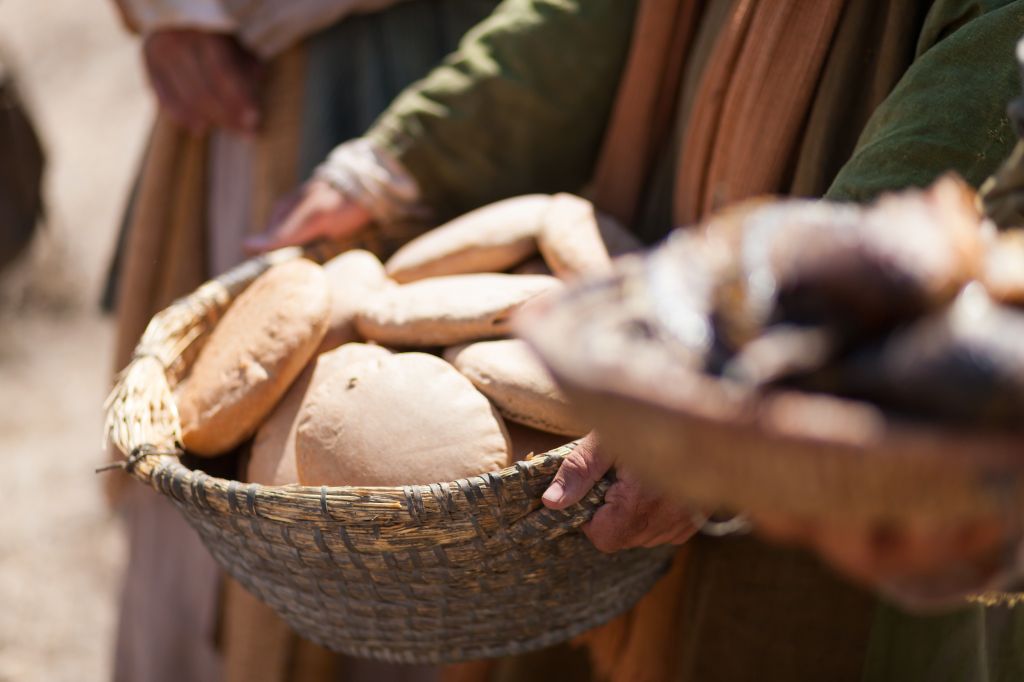
This first Sunday in August is traditionally known as Lammas-tide. Lammas comes from the term ‘loaf mass’. Traditionally in Celtic times, it was a bad idea to harvest your grain any time before Lammas because it meant that the previous year’s harvest had run out early. However, on August 1st the first sheaves of grain were cut by the farmer, and by nightfall his wife had made the first loaves of bread from the first of the season’s wheat crop. A loaf was then brought into church to be used for the Communion bread. It was a day of thanksgiving, so no surprise that today’s gospel reading features the theme of bread.
When we look at the gospels it is always interesting to see which stories get mentioned by all 4 writers and which ones don’t. Only Matthew and Luke include the stories of Jesus birth, so, if it were down to Mark and John we wouldn’t have much about Christmas at all. John, on the other hand includes the raising of Lazarus, (a pretty major miracle event) and yet for one reason or other Matthew, Mark and Luke leave it out.
But the one thing all 4 writers include is the story of the feeding of a crowd of over 5,000 people…
So, I wonder why they did this?
Well, I am guessing that when Matthew, Mark, Luke and John were pondering how to tell the story of Jesus they had to weigh up what to leave in and what to leave out, I am sure that none of them had the time or space to share everything they heard and remembered, yet this particular story was one that they all wanted to share.
Perhaps first and foremost because it’s about food…
Food evokes feelings…
I remember several years ago reading a piece from an estate agent who said that one of the best ways of selling your house is to put bread in the oven just before potential buyers arrive, the smell of baking makes the house feel warm and welcoming.
Food also evokes memories…
A special meal out,
A romantic dinner for two,
A birthday party.
The Christmas dinner… even the one where the sprouts got burnt!!
Food evokes stories…
The first readers of the gospels would have been raised on stories of how God freed their ancestors from slavery in Egypt, and when they were in the wilderness God gave them food every day, Manna they called it, bread from heaven.
Other readers would remember the time when Jesus was at table with his disciples he took bread and broke it and gave it to them saying ‘This is my body given for you; do this and remember me’, just as we will be doing a little later on…
So, this story of the loaves and fishes is brimming with history and connection, reminding us that not only is God moved by human needs, but he is also able to meet human needs. When God promises life in all its fullness, we have good reason to take God seriously. 5,000 men not counting the women and children all fed from 5 loaves and 2 fish with enough left over to fill 12 baskets. It’s a miracle and perhaps we ought to leave at that!
However (and you just knew there was going to be a however) miracles do tend to nag at those of us who don’t experience them very often. We tend to wonder about the details.
Did Jesus multiply the loaves all at once or did it happen as the loaves were being handed through the crowd?
As someone tore off a hunk did the loaf suddenly grow bigger?
Or did new loaves appear when no one was looking?
How EXACTLY did it happen?
Matthew doesn’t tell us. What he does tell us is that this miracle happened in a lonely/ deserted place where Jesus had gone to be alone, after he heard the terrible news that his cousin John the Baptist had been murdered.
But when the crowds discovered where he was, they followed him on foot from the towns. He may have needed to be alone, but they also had their own needs. They were sick, sad, and now they were hungry too. Anyone but the Son of God might have told them to get lost, but Jesus had compassion on them, his heart went out to them.
So, when evening came the disciples found him and suggested that he send everyone away to buy supper in one of the nearby villages. They meant no harm; they were simply being practical. It was time to call it a day, to build a campfire and eat the little bit of the food they’d brought with them. It was time to take care of themselves for a change and suggest that everyone else did the same. But Jesus had a better idea. “They need not go away!” he said, “YOU give them something to eat.”
I wish I could have been there, don’t you? I wish I could have seen how they looked at each other when he said that. Give them something to eat? What US?
You’re in charge here, Jesus; you’re the boss. What do you mean, we should give them something to eat? All we have between us is five loaves and two salt fish. There are five thousand people out there, Jesus. No disrespect intended, but you’re not making any sense.
He may not have been making sense, but then again, he may have had a sense of the situation that went beyond the disciples’ “common sense”.
They were, after all, operating out of a sense of scarcity. They looked at the crowd, saw no picnic baskets or backpacks, and assumed that no one had anything to eat. They looked at their own meagre resources and assumed that it wasn’t enough to go around their own circle, much less to feed the whole crowd.
But Jesus operated out of a different set of assumptions. If the disciples operated out of a sense of scarcity, Jesus operated out of a sense of plenty. He looked at the same things the disciples looked at, but where they saw not enough, he saw plenty
Plenty of time, plenty of food, and plenty of possibilities with the resources at hand.
Not that he knew exactly how it was all going to work. He was human, remember, as well as divine— but what Jesus knew beyond a shadow of a doubt was that wherever there was plenty of God, there would be plenty of everything else. So, he asked the disciples to bring their food to him, and he ordered the crowd to sit down on the grass, and he proceeded to bless five loaves and two fishes in front of them all, perfectly confident that God would turn ‘not enough’ into plenty.
Can you imagine what it must have been like? To be sitting in that crowd, watching a rabbi bless five loaves, and break them, and give them to his disciples to give to a crowd that went on forever?
Unless you were on the front row, chances are you might not have seen it at all. You might have had to nudge your neighbour and say, “What’s going on up there?” and he might have said, “You’re not going believe it—that Jesus fellow just said grace over five loaves and two fish and now some of his men are passing them out through the crowd. It’s the craziest thing I’ve ever seen, but don’t get too excited— it’ll all be gone before it ever gets to us.”
Some of the crowd must have laughed out loud, others would have been mystified, still others were embarrassed for Jesus, that he should have promised so much with so little to deliver.
But I wonder if some of them weren’t also moved. I wonder if they didn’t look at that small basket going around and feel the food hidden in their own pockets beginning to burn a hole.
Because they remembered that bit of lamb wrapped in a grape leaf, a few raisins, a chunk of bread left over from breakfast. Something they had tucked away before heading out on foot to a lonely place. Wouldn’t you have done the same?
But it wouldn’t have been enough to share, so chances are they kept it hidden— wrapped in a handkerchief, stuffed up a sleeve—waiting for an opportune moment to go off alone and have a sneaky bite. And it might have worked, if that bread-basket hadn’t come around, full of scraps, everyone so careful not to break off too much, everyone wanting Jesus’ crazy idea to work. So much so, that very carefully, very secretly, they began to put their own bread in the basket, reaching in as if they were taking some out but leaving some behind instead, so that the meal grew and grew…
And in the end when the disciples collected the broken pieces, they stared in amazement at 12 baskets full of bread—of all kinds that started off with 5 blessed and broken loaves.
But that’s not a miracle Rose! Isn’t that what you’re thinking? That’s just human beings being generous, sharing what they have—even when it is not much, even when it is not enough to go around.
That’s not a miracle! That’s just people refusing to play the age-old game of what’s-mine-is-mine-and-what’s- yours-is-yours. People turning their pockets inside out for one another without worrying what’s in it for them.
That’s not a miracle!…… Or is it?
The problem with miracles is we tend to get mesmerized by them, focusing on God’s responsibility and forgetting our own. Miracles let us off the hook. They appeal to the part of us that’s all too happy to let God feed the crowd, save the world, do it all.
What we have to offer is not enough to make any difference anyway, so we just hold back and wait for a miracle, looking after our own needs and looking to God to help those who can’t help themselves. If Jesus is in charge of the bread, doesn’t that excuse us from sharing our own? God will provide; let God provide.
And for ‘bread’ we can also read: Our talents, our energy, time, and commitment.
“Send the crowds away,” the disciples say, “So they can buy food for themselves. “They need not go away,” Jesus replies, “You give them something to eat.”
Not me but YOU; not my bread but YOURS.
Not sometime in the future or somewhere else but RIGHT HERE AND NOW!
Stop looking for someone else to solve the problem and solve it yourselves.
Stop waiting for food to fall from the sky and share what you have.
Stop waiting for a miracle and participate in one instead…….
When it comes to the loaves and fishes, no one knows how it really happened. Your guess is as good as mine. I’ve no doubt that had he chosen Jesus could have fed that crowd from scratch with nothing at all, all by himself. But he didn’t chose.
And what Jesus says to his followers here he continues to say to us today: “They need not go away; you give them something to eat.” And if those words strike fear in our hearts, (because the loaves that we have seem like nothing at all), we have only to remember what he says next: “Don’t be scared, just bring them to me.”
Preached on Sunday August 6th 2023 at St Andrew’s Corton Denham. Thoughts inspired in part by The problem with miracles. The seeds of Heaven preaching the Gospel of Matthew by Barbara Brown Taylor
In these early days of January members of the Christian family across the world will be celebrating the feast of Epiphany. We will hear the account of the wise men or magi from the East seeking and finding the Christ child, guided by a star, bringing their gifts and bowing in worship before him.
The word ‘Epiphany’ means showing or ‘shining forth’. Divine light shines from this child. Yet it should not so much be understood as the appearance of God as the transparence of God. The divine light that shines in the Christ child is not a light which is foreign to the earth, it is the Light which is at the heart of all life, the Light from which all things come. If somehow this Light were extracted from the universe, everything would cease to exist.
So, the message of Epiphany is about the Light at the heart of everything. The Light at the heart of you, the Light at the heart of me. Sometimes it may become hidden or neglected or dimmed by fears and anxieties. But still, it is there waiting to shine as we discover in the following reflection.
Summer has come and almost gone. I hope you managed to enjoy a change of scene either in the form of a staycation or just a little break from regular routine, as a friend said to me recently just a couple of days spent not too far from home can actually be more refreshing than all the hassle of airports or busy motorways.
Looking out of my study window the trees are not yet quite ready to change colour but in the morning there is mist, lovely tiny sparkling dewy cobwebs on the lawn and blackberries in the hedges, a sure sign that autumn is on the way.
In our little community, there is much excitement about our village photographic exhibition. Everyone has been invited to send in 3 photos taken in our local area they can be landscapes or pictures of people or animals and then 12 will be chosen by popular vote to feature in our very own ‘Countryfile’ style calendar, with profits shared between our local church and village hall. I have been amazed at the number of entries and the interest in this project. Those who might have said I can’t take a photo or mine won’t be good enough because I’m not a professional photographer have send in their contributions and all of them are wonderful.
For me this season of harvest always seems special. A time of thanksgiving and celebration that all is safely gathered in. A time to show appreciation for the much-valued efforts of our farmers and producers, especially during this challenging year, and also a time to give thanks to God for the richness and beauty of creation.
This year our Harvest falls the day before the Feast of St Francis of Assisi. In recent years Francis has been championed by some as the patron saint of animal welfare, ecology and environmentalists. There are many pictures in story books and stained-glass windows of Francis preaching the gospel with a cute menagerie of furry, feathered and fishy creatures listening at his feet. He’s even credited with staging the first outdoor nativity play in a barn with real straw, real baby and real animals, people came from miles to see it. So, it’s tempting to take a rather sentimental view of him….
However, in truth Francis was a strange and rather intense young man, who rejected the demands and responsibilities of his wealthy family, much to the anger of his father, and went off to live very simply attracting a small group of followers around him. He was what we might call a prophet. He saw things that other people didn’t see, heard voices that other people couldn’t hear. If he walked into any of our churches right now, I think he’d set our alarm-bells ringing. Like Jesus, he saw the world with uncomplicated clarity and humility. He believed that we should pay attention to everything God has made, not just to people who need help but to every single thing around us.
Although I feel it would be wrong to read Francis as a modern day eco warrior, especially as many of the issues we currently face would have been completely unknown to him, there is still a great deal in his sense of reverence and thanksgiving which found its out-working in a care and respect for all living things which speaks to us across the centuries.
For Francis the beauty, colour and variety of creation was a source of constant wonder and led him to praise a creator who was greater than all these things. It has been well said that the natural world was Francis’ cathedral, witnessing to God’s glorious abundance.
Around 300 years earlier the Celtic philosopher, theologian and poet John Scotus Eriugena taught that Christ walks among us in 2 sandals The one sandal is Scripture the written word of God, the other sandal is creation. Eriugena was aware that some people who have never discovered God in the one have found him in the other.
In our modern day for some it can be tempting just to concentrate on creation and forget about the Scriptures and yet the great French microbiologist Louis Pasteur declared: “The more I study nature the more I stand amazed at the work of the creator. Science brings men nearer to God.
So, maybe we need to re-discover the art of reading the 2 side by side so the one can inform the other and offer a different perspective. If you had suggested to Francis, he had to choose between the two ‘sandals’ I think he would have been very puzzled. Yet perhaps it has become more difficult for us to speak of God’s presence finding expression through the natural world in an age where some dismiss the idea of God completely. Maybe we need to re-discover the creativity, imagination and simplicity to do so, the ability to stand back in wonder and awe without having to figure everything out. The psalmists wrote often of God’s glory perceived in creation and praised by celestial beings. In their timelessness the Scriptures remind us that the earth does not belong to man, man belongs to the earth, all things are connected like the blood that unites us all. Man did not weave the web of life; he is a merely a strand in it. Whatever he does to the earth he does to himself.1
As we enjoy the beauty of autumn and creation in general, whether through getting out and about to explore or though fantastic natural life films like the Blue Planet series, this piece of wisdom is something we need to constantly keep at the forefront of our actions and our minds, so that future generations may enjoy it as well.
So, to conclude this harvest ramble a moment of reflection with a few local scenes celebrating the beauty of creation and then the words of a hymn by Shirley Erena Murray which we might chose to use as a prayer.
A year in the life of the Village
Touch the earth lightly, use the earth gently, nourish the life of the world in our care: gift of great wonder, ours to surrender, trust for the children tomorrow will bear.
We who endanger, who create hunger, agents of death for all creatures that live, we who would foster clouds of disaster, God of our planet, forestall and forgive!
Let there be greening, birth from the burning, water that blesses and air that is sweet, health in God’s garden, hope in God’s children, regeneration that peace will complete.
God of all living, God of all loving, God of the seedling, the snow, and the sun, teach us, deflect us, Christ reconnect us, using us gently and making us one.
Today we celebrate the coming of the Holy Spirit on the first disciples and also the birth of the Christian Church. So, although it sometimes slips by unnoticed it really is a red-letter day. Pentecost comes 50 days after Easter and marks the day when Jesus’ promise to his followers, that power from on high will come upon them, is fulfilled.
Some people know Pentecost by the old English name of Whitsun or ‘White Sunday’. Often on this day people were baptized and wore special white robes for the occasion. Most of all it is a time when we focus on the Holy Spirit, on this day we pray that the Spirit may come upon us filling us with wonder, love and praise, spilling over from our lives in new and creative ways and touching the lives of those we meet.
So, for this Pentecost Occasional Ramble, I would to share a few thoughts and then a reflection in music and pictures.
First, the thoughts.
I’m guessing until a year ago most of us would never have given it a thought! What is it? Let me give you a clue, ‘It’s as natural as breathing,’ we say. All living things need breath and if by chance when they arrive, they don’t take that vital first gulp of air someone is there with a helping hand; to give a baby a slap on the back or in the case of a calf or a lamb to quickly baptise them in ice cold water, swing them round by their hind legs, or stick a piece of straw up their nose. Welcome to the world little one you’re gonna be doing this 24/7 for the whole of your earthly span.
With the advent of Covid 19, we have rapidly become aware of how breath is also a living thing. Viruses are transferred through breath, more specifically the droplets within our breath. Face masks appeared, along with social distancing and hugging was definitely off. Scenes of people struggling for breath, on ventilators in hospital, needing oxygen to survive, have made us all too well aware of the vital connection between life and breath.
So, this year as we celebrate Pentecost, as we gradually start to breathe a little more easily and things begin to open up perhaps more than ever before, we ‘get’ this connection between life and breath.
As I read the passage set for Pentecost Sunday from Acts Chapter 2, the coming of the Holy Spirit with rushing wind and tongues of flame and a bunch of inadequate disciples being instantly transformed into 1st class preachers, I wonder if this is really how it went.
By this point in their journey, the disciples were probably quite breathless themselves. A great deal had happened in the last 50 days. Jesus had been arrested and crucified, buried in a garden tomb. But just at the moment when they were at their lowest, something took their breath away. Jesus had promised this, of course, but somehow, they never quite took it in. Yet there he was standing among them, and in the course of their short time together, they met, they talked, they ate with him. They had breakfast on a beach, one found answers to his questions, one also found forgiveness, all found new joy and confidence.
But just as they were catching their breath, Jesus did exactly what he said he would do, he left. And so, the disciples did what church people often tend to do in times of fear and chaos- they had a meeting. They busily began to trying to get a game plan together, Jesus had left them so much to do, they really had to get organized. Boy, it was a daunting task! They really needed a mission plan.
The only breath in the room on that day came from sighs of anxious frustration. A sense of not being up to the task, stifled by their own limitations along with a whole series of questions.
How on earth can we manage to do all the things we need to do? How can we preach the word like Jesus? How can we care for the poor like Jesus? How can we speak to the powerful like Jesus? How can we bring healing like Jesus? How can we make disciples like Jesus?
None of us can do any of these things so perhaps we ought to find someone who can do all of them for us, call it a minister, priest or leader, the name’s not important it’s capability that counts. We would be right behind them…of course!!!
But as they sat pondering, all of a sudden whoosh! From out of the blue came a might wind, heading straight in their direction. It blew through the house, raising the dust, rattling shutters filling each one of them with a breath that seemed to come from somewhere else, and indeed, from someone else. They’d not asked for this breath or expected it. This Spirit simply swooped down upon them and filled them in ways they could never have imagined, and with it, they found, that YES, they had gifts they never even knew they possessed. And so, what did they do next?
Once the disciples discovered they could breathe again, once they shook themselves loose from the knot in their throats, they found themselves speaking naturally about everything God had done. They burst out in languages they did not even know they could speak-telling the story of how once they were no people, but now they were God’s people. Once they had no name, no faith and no future, but now they were God’s own sons and daughters.
What’s more these timid, stressed-out disciples found themselves preaching and sharing their faith in ways that were simply so compelling that people had to stop and listen. As the crowd grew, some thought they were drunk, and had we been there on that day we might well have imagined the same, there was no rational explanation.
But then Peter stood up and spoke. And I like to imagine all these people-from near and far, strangers and foreigners, young and old, beginning to breathe more easily, beginning to savour the fragrance of God and deeply inhale the Spirit. And thus, the church took its very first breath, not with a smack on the back and a cough, not with a bucket of icy cold water. NO, in that very first moment it flew! As people from far and wide, all kinds of languages and traditions, began to speak of the wonder of God. And this breath/this Spirit blew freely, swooping and soaring and dancing among them. And, like a beautiful multi-coloured balloon Christ’s body, the church filled with life, lifted off and set sail on its journey.
But here’s the kicker in the story! Because whilst it is a lovely story, a meaningful story, a powerful story we can’t keep it rooted in the past. God’s Spirit still works in the very same way, the Holy Spirit, the breath of God is at work right here and now. And here’s the shocking/surprising part, it’s not restricted to the church, either the people or the building. You see it when people pray together, talk together, listen together, spark and become creative together. You see it in music, poetry, art, in nature and everyday conversation.
God’s Spirit will not be limited. It challenges, sometimes it scares, it comforts us and enlightens us, this is why the Spirit is sometimes called ‘Wisdom’. It is God’s moment by moment gift, we may call it air, breath or Holy Spirit, but whatever label we chose to use, it invites us to warm it and lend it our lives. In return it promises to fill us with life, set our hearts on fire give us words to speak of mysteries we can’t begin to comprehend. So just sit back, take a deep breath, savour the fragrance of God’s Holy Spirit.
The story of Pentecost reminds us if we are open to breathing it in, if we dare to pray “Come Holy Spirit,” our lungs will be filled to the gills with courage, strength, hope and faith we never even knew we had.
And so, on this Pentecost Sunday, I invite you to reflect for a moment on how you picture the Holy Spirit and then to end with a couple of simple prayers.
Reflection
A Pause for Prayer
Blessed are you, Creator God: Your Spirit moved over the face of the waters bringing light and life to all creation. Pour out your Spirit on us this day, that we may walk as children of light and by your grace reveal your presence, Father, Son and Holy Spirit. Amen.
God of power, may the boldness of your Spirit transform us, may the gentleness of your Spirit lead us, may the gifts of your Spirit be our goal and our strength now and always. Amen.
As we begin our journey through Holy Week it almost seems that between Palm Sunday and Maundy Thursday nothing much is happening. It’s tempting to skip through and cut to the chase, focusing on the last supper, the crucifixion and then on to Easter day.
But along the way there are characters and stories all part of the greater narrative inviting us to pause and reflect. And in this Holy Week reflection the fragrance of love, through words, pictures and music in the video below I’d like to invite us to explore two of them.
Once in a while you see a movie or read a book that makes a really lasting impression. For me one such book is Quarantine, now if that’s not a ‘right on message’ title I’m not sure what is!
Written in the mid-1990s by Jim Crace, Quarantine tells the fictional story of how, two thousand years ago, four travellers enter the Judean desert to fast and pray for their lost souls. Here in the blistering heat they encounter all kinds of perils, some imaginary and some real, including Musa, an evil merchant, a kind of Satan figure, who preys on their vulnerability, plays with their minds and holds them in his tyrannical power. Yet out in the distance there is another, a faint figure who has come into the wilderness in order to fast for 40 days. A Galilean who they say has the power to work miracles.
Rather than doing a plot spoiler by giving away the story or the ending I will simply say that if you’re looking for a challenging read, which may at times take you out of your comfort zone, Quarantine has a timely message. About the battle between good and evil and how human beings respond in crises, both physical and spiritual. Most of all it speaks about change. Having entered the desert, the characters in the novel evolve. Through their wilderness experience they meld and mould and mellow, or sometimes not. But certainly, by the end of the story their horizons have widened and none of them will ever be the same.
Talking with several friends I sense an important part of our story this Lent will involve spending time in reflection on what we’ve discovered in the past year, and most importantly what has challenged us and changed us.
At the start of Lent last year my diary was full, I was rushing around like a mad bear with a list of things to do: Ash Wednesday ticked that one off, Lent course got that one too along with all kinds of meetings and parish events which we believed were so very important.
And then on Mothering Sunday, (co-incidentally also known as Refreshment Sunday) everything suddenly ground to a halt. I was sad to lose Mothering Sunday and to have to stop the Lent course too because it had just begun to get interesting.
Yet there was something in my heart that welcomed the slowing down of pace. A space to draw a line in the sand, to step back from the conveyor belt of day-to-day activity with its local/parochial emphasis and have the opportunity for space to actually stop and reflect on wider and deeper things.
One thing is for sure, as we set out on Lent this year our horizons will have changed. For some the boundaries will have narrowed, being confined to our own 4 walls but for others horizons will have widened. Creative spirits will have been sparked into painting, writing, composing music, making films, walking, praying, cooking, craft work or even, like us, simply taking photographs.
There is, I sense, in many folk a feeling that when ‘normality’ resumes, life will not be quite the same, and in some ways this will be for the good.
My hope is that when life moves on, we may remember the lessons we’ve learnt. The importance of kindness to one another, counting our blessings day by day, celebrating small but important things and making time to stop, look and ponder.
As I wish you every blessing on your Lenten journey let me share the following prayer:
God of all seasons in your pattern of things there is a time for keeping and a time for losing, a time for building up and a time for pulling down. In this holy season of Lent, as we journey with our Lord to the cross help us to discern in our lives what we must lay down and what we must take up what we must end and what we must begin.
The Book of Common Order of the Church of Scotland.
As I post this first offering for the New Year somehow the theme of light in the darkness seems very appropriate. The last few days have brought bad weather to many with flooding and snow causing problems in equal measure and we currently find ourselves into our 3rd session of lockdown within the space of a year. Some friends have given up on watching the news because, in spite of hope on the horizon in the shape of a vaccine, the daily reports with their spiralling statistics are just so depressing.
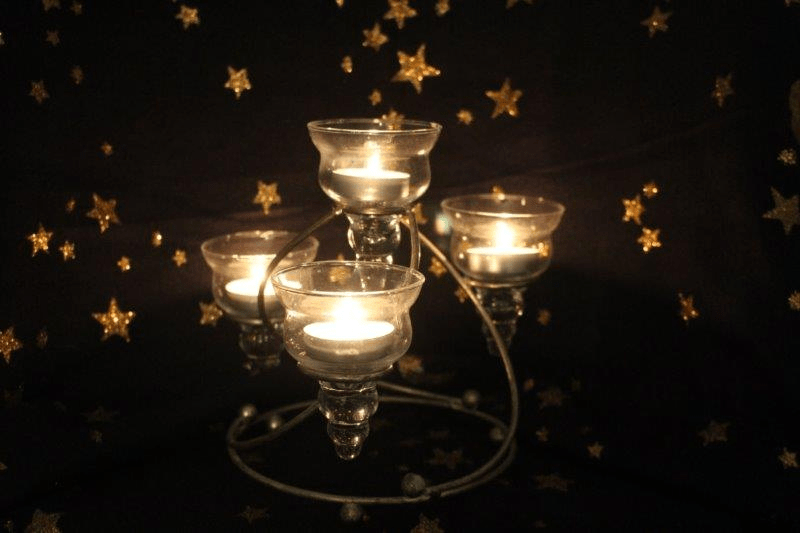
Yet looking out of my study window in the natural world there is hope on the horizon. The shortest day is behind us, the evenings are beginning to draw out and although it may not feel like spring the birds are beginning to sing, from deep in the earth small signs of life and hope are starting to appear if only we are able to see them. This message of new life and hope is one of the major themes of Candlemas which we celebrate on February 2nd. There are of course many traditions surrounding this day and indeed the beginning of February. One ancient rhyme connected with the festival says:
If Candlemas day be sunny and bright, winter again will show its might. If Candlemas day be cloudy and grey, winter soon will pass away.
In North America February 2nd is Groundhog Day. The name comes from good old fashioned folk lore brought to America by Dutch and German speaking settlers. Originally the legend said that if the badger (which was revered back home as a reliable forecasting animal) emerges from its burrow on this day and sees its shadow because the sun is shining it will retreat to its den and winter will persist for six more weeks. However, if the day is cloudy and there is no shadow then spring will be early. On arriving in their new land, the settlers were dismayed to discover a shortage of badgers and so as the next best thing the responsibility for forecasting the beginning of spring passed to the humble Groundhog, as the great Michael Caine once said “not a lot of people know that!”
However we choose to mark the beginning of February, at this time of the year as the darkness begins to recede, my hope and prayer is that we may make the effort to seek out those signs of new life and hope, whatever shape or form they may take, and take the time to share them with others.
After the following quote and prayer you will find a video with reflections on Candlemas in words, music and pictures.
Sometimes when you’re in a dark place you think you’ve been buried, but actually, you’ve been planted.
Christine Caine
Lord, bless to us your light in our darkness bless to us your hope in our hearts bless to us your peace in our homes.
Prayer taken from Dreamers and Stargazers Chris Thorpe Canterbury Press
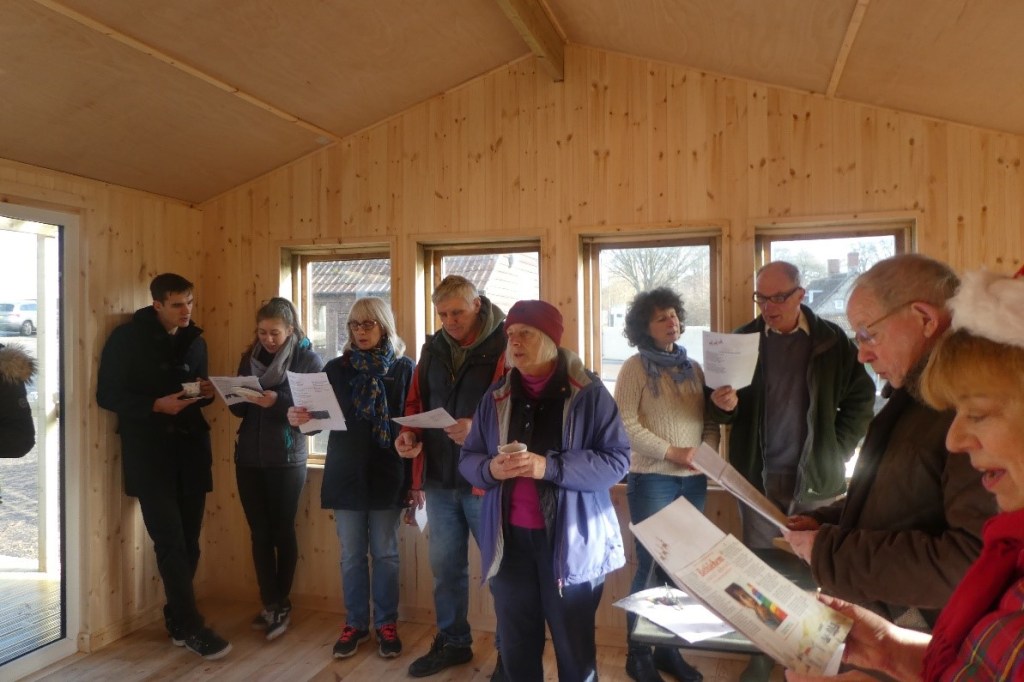
This time last year a group from our local church were singing carols at our local farm shop.
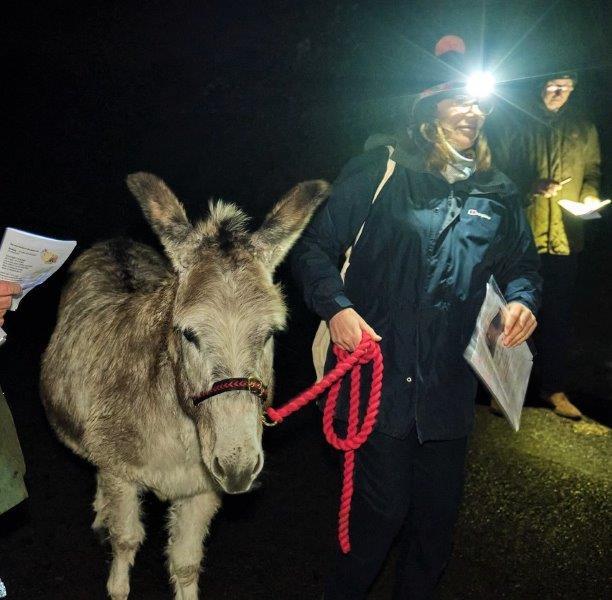
And on a blustery winter night we joined in a ‘walking nativity’. As we re-imagined Mary and Joseph’s journey from Nazareth to Bethlehem we made our way round the village accompanied by donkeys, a star and, even for part of the journey, a baby. All ending up with a final carol, mince pies and mulled wine in church.
This year things will be different; we are all having to discover new ways of celebrating Christmas at a time when the message of hope and light at the heart of the story seems more important than ever.
In creating this Christmas Ramble I have put together a selection of thoughts, music, a story and a carol as a little gift. I am hoping that, amid all the current upheaval, it may help to remind us that at the heart of our celebrations is one who brings light into the darkest places, rest to those who are weary and comfort to all who are down hearted.
I hope you may find a few quiet moments, either before Christmas day or during the Christmas season, to enjoy it perhaps with a coffee and a mince pie or even a glass of mulled wine.
And that, in the words of an ancient Celtic blessing
You may be blessed with the spirit of the season, which is peace, The gladness of the season, which is hope, And the heart of the season, which is love.


 Rose's Occasional Ramble